The Bipolar IN Order Academy teaches you to see mania and depression as states you can learn to understand and move through. You build a personal picture of your environments, behaviors, comfort zones and tools, and that becomes a self-management system made for you. It works alongside your doctor and therapist, never in place of medication or therapy.

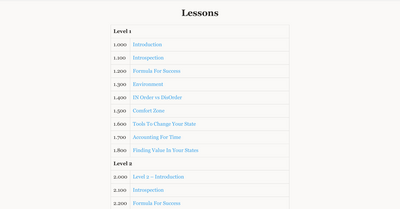
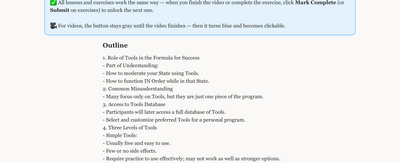
The Academy is a series of lessons, numbered 1.0 through 8.8, each combining video and reading. Inside the lessons are exercises: short interactive forms you fill in before moving on.
Those exercises are how the program learns about you. You rate how each environment affects your mania and your depression, note the behaviors you see in each state, set the edges of your comfort zone, choose your tools and set up your timeline. By the end it is not a worksheet anyone could fill in; it is a system shaped around the way you experience your states.
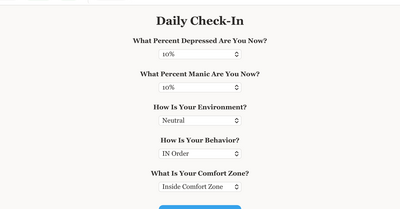
Each day you spend about 30 seconds recording where you are: your mania, your depression, what is happening around you and how you are handling it. Day by day those entries add up to a detailed record of you, and that record powers the AI coaching, the reports and the patterns the program finds.
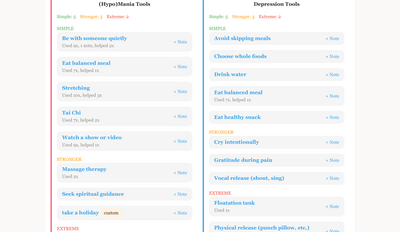
Every time you use a tool, the program notes whether it helped and under what circumstances. A short monthly survey asks about healthcare use, such as hospital stays, ER visits and medication changes, and those answers feed the cost savings analysis.

Nearly everything comes in pairs. Mania and depression each have their own tools, environment ratings, timeline settings and comfort zone thresholds, because the two pull in opposite directions: what helps in depression can be the wrong move in mania, and the reverse is true too.

You don't get everything on day one. Daily check-ins come first, then tools and reports, then the timeline and the rest of the program, each opening as you move through the lessons. That keeps the start manageable and means you understand each feature by the time you reach it.

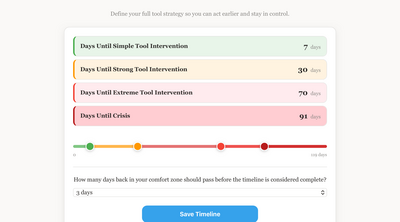
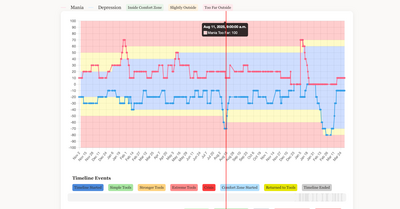
If your check-ins show you heading outside your comfort zone, the program starts a timeline: a series of responses that begins with simply noticing and moves to stronger tools only if things keep building. Mania and depression each run their own timeline, and you decide how many days each phase lasts before the next one begins.
The phases go from watching, to simple tools, to stronger tools, to extreme tools, and finally to a crisis response. You respond with a plan instead of reacting in the moment.

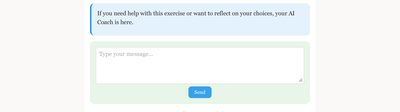
You'll find the AI coach in the lessons, the exercises, the tools and the reports. It asks you focused questions based on your own data, helping you build self-awareness and spot your patterns. It is not a therapist and gives no therapeutic advice. Its job is to keep your insight growing between sessions, not only during them.

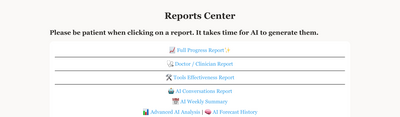
Reports show how you are doing over time: your mood trends, the tools that are working for you, your behavior patterns and insights from the AI.
You can share your check-ins, tool use, AI coaching conversations and reports with your therapist, doctor, family or researchers, and you set exactly what each person can see. Your therapist might see the clinical report and tools data while your spouse sees only the weekly summary. You stay in control and can take access away at any time. Every view is logged for HIPAA compliance.

As you move through the program you pass through stages you can measure: Managed, Freedom, Stability and Self-Mastery. Each stage looks at intensity, awareness, understanding, functionality and comfort.